Christian Charity

Sermon Manuscript:

“May the God of endurance and encouragement grant you ato live in such harmony with one another, in accord with Christ Jesus, 6 that together you may with one voice glorify bthe God and Father of our Lord Jesus Christ. 7 Therefore welcome one another as Christ has welcomed you, for the glory of God.”

Romans 15:5-7

Start With Who God Is

In verse 5 of our text, The Apostle Paul uses the words “endurance” and “encouragement” as titles for God. The KJV uses similar words: “patience” and “consolation.” The Bible is filled with titles and attributes used to describe who God is. Here are some of them: “Father of lights” (James 1:17), “King of glory” (Psalm 24:8), “possessor of heaven and earth” (Genesis 14:22), “Ancient of Days” (Daniel 7:9), “the Father that has bought you” (Deuteronomy 32:6), “the One in whom we live, and move, and have our being.” (Acts 17:28). Paul uses these words: “patience” and “encouragement” here to emphasize certain attributes of God. And these righteous attributes are exactly what members of the Roman church, and us today, need the Holy Spirit to work into us, in order to maintain harmony with one another. 

We can understand Romans 15:5-7 as a statement of what Paul asks God for in his prayers for the Church, and before giving an imperative, or an instruction to believers, he begins by directing his attention, and the attention of the reader, first to the reality of who God is. A French theologian once said, “True and substantial wisdom principally consists of two parts, the knowledge of God, and the knowledge of ourselves.” 

God. Self. God again.

When we think about what it means to be a Christian, and how to live as one practically, it would do us much good to begin with God, and see the end in God. Let me give you an illustration: The source of all created things is God, He is the beginning. It all starts with Him. From Him we are made, and we realize our sinful state by comparing ourselves to the righteousness of God. This is the knowledge of self. God is holy, we are not, and so God saves us, and we enjoy Him forever. That’s the end goal. What is the chief end of man? To glorify God and enjoy Him forever. Knowledge consists of (1)God, (2)Us, (3)The return back to God.

He is the alpha and the Omega. The source of not only our existence, but our salvation, is God Himself, Father, Son, and Holy Spirit. And before we consider our instructions as believers, we should first focus our attention on who God is. Psalm 34:8 says “Oh, taste and see that the LORD is good! Blessed is the man who takes refuge in him!”Notice that seeing the goodness of God comes first, and after comes the taking of refuge in him. So Paul starts with those two words, endurance and encouragement, to tell the church, that God is the kind of God that delights in patience, encouragement, and endurance that Christians show each other. 

“Live in harmony with one another, be charitable,” Paul says. Before Paul gives the instruction, he lays the foundation to act first with the understanding of God’s character. Our actions flow from an understanding of who God is. Our thinking should start with Him.

Context for Our Passage

Let’s understand the context for our passage today.

In chapter 14 , Paul as inspired by Holy Spirit address the contention that existed between Christians in the Roman congregation, a mixture of Jews and Gentiles. Chapter 14:1 says, “As for the one who is weak in faith, welcome him, but not to quarrel over opinions.” Paul then let’s us in on what these specific quarrels were about.  14 verse 2 says, “One person believes he may eat anything, while the weak person eats only vegetables. Let not the one who eats despise the one who abstains, and let not the one who abstains pass judgment on the one who eats, for God has welcomed him.” 

The “vegetables only” group was either referring to Jewish believers who strictly followed the Torah’s dietary laws, or Christians who had personal convictions about eating any meat connected to pagan rituals and idol worship. To avoid guilt these believers would rather exclusively eat vegetables than eat any meat at all. Yet, regardless of whether this view is correct or not, Paul says that they should not be despised, because God has welcomed them.

Paul describes another topic that believers in the congregation were quarreling about. He tells us in verse 5 that believers in the church were also disputing over sacred days. “One person esteems one day as better than another, while another esteems all days alike. Each one should be fully convinced in his own mind.”

By mentioning the observance of days, Paul lets us know that he is talking more about principles than specifics. If he was aiming to present doctrine to the church about which days to observe and which ones not, he would have named them, whether that be the Feast of booths, passover, the feast of weeks, etc.

What is Paul’s response to the division over these issues? Verse 6 “The one who observes the day, observes it in honor of the Lord. The one who eats, eats in honor of the Lord, since he gives thanks to God, while the one who abstains, abstains in honor of the Lord and gives thanks to God.”

Paul says that in matters of conscience, each one should be fully convinced in his own mind, acting on faith that his actions are pleasing to God, according to chapter 14 verse 22. 

Here’s another illustration

We have Saint Joe from down the road, and Saint Tom from around the block, who both attend the same church. Joe will occasionally attend group hangouts at a friend’s place, along with other old high school friends that Joe grew up with. It’s a mixed crowd, some are Christians and some aren’t, but they all know that Joe takes Christ and His word seriously. Now the day’s events consisted of cornhole, barbeque, football, and… beer. Joe participated in all the activities, including the beer… without getting drunk. At Bible study the next week Joe tells the other guys about his time last weekend with his old high school friends… including the beer. 

Tom, being a former alcoholic, protests. Their discussion continued a while after Bible study, and to Tom’s dismay, Joe showed no conviction or regret about drinking beer at the party. To make matters worse between these two, the following Bible study conversation reveals that Joe and Tom don’t agree on how to interpret certain verses in the Book of Revelation! Forget beer, how could you possibly think that the anti Christ was nero!? 

Over time, Tom and Joe’s friendliness towards each other grew cold, and they eventually stopped talking to one another, and even avoiding each other. If Joe ever came up in conversation with others at church, Tom would make subtle remarks that encouraged others to doubt Joe’s character.

Now the point here, is not to say that intense, and possibly even fiery, theological discourse with a brother or sister is ungodly. Quite the contrary. Talk about your convictions if they come up. Present coherent arguments as to why you think what you do. “Iron sharpens Iron.” (Proverbs 27:17) But the point here is that Christ requires that we do this to each other’s edification. Our passage today says that we are to live in harmony with one another, and putting up walls of association is antithetical to this command. We must not commit murder, and no, not literally “knocking someone off”but rather, if we see the underlying heat issue, murder can look like intentionally taking steps to remove a person from your life or circle that should be there. 

“Everyone who hates his brother is a murderer, and you know that no murderer has eternal life abiding in him.” (1 John 3:15)

Weighty words from John.

“You have heard that it was said to those of old, ‘You shall not murder; and whoever murders will be liable to judgment. But I say to you that everyone who is angry with his brother will be liable to judgment; whoever insults his brother will be liable to the council; and whoever says, ‘You fool!’ will be liable to the hell of fire.” (Matthew 5:21)

Christian charity requires welcoming brothers and sisters, even those that disagree with you on topics of less importance than the gospel itself.  

Now some of us here today can be described as “doctrinaire Christians.” Containing a high degree of interest in doctrinal systems and theories. Sometimes inflexible, systematic and analytical thinkers. Others think more easily in practical terms. Gifts and talents within the body of Christ are not homogenous, and yet a temptation is to go to war with anyone that might have a different conviction on minor doctrinal matters that we can safely say exist in the realm of conscience. 

I tend to agree with Pastor Wilson’s view on the federal government not establishing a specific Christian denomination on the national level. (Feel free to give me pushback after service) Yet, he argues for America adopting Christianity in politics and government.

 In his book Mere Christendom, Pastor Wilson applies this to Christian government, saying “…when the doctrinaire Christians get power, one of their temptations is that they want to impose their whole system, down to the jots and tittles. We must refrain from doing this, not because truth is relative, because it isn’t, not because truth is a matter of community-perspective and there are multiple communities, for that is incoherent, but we must refrain from doing this because Jesus Christ demands that we refrain.”

On the other hand, unity among believers is not achieved by willful ignorance of minor doctrinal or tertiary matters. That word “Tertiary” refers to doctrines over which Christians may disagree and remain in close fellowship, even within local congregations.“ Proverbs 24:3 says, “By knowledge a house is built.” Learning is good. Curiosity is good. Diligent study is good. But independent of conclusions, the instruction remains the same. Show Christian charity.

Back to our passage: The Holy Spirit’s wish for the church in our passage, chapter 15 verse 5 is that “the God of endurance and encouragement grant you (churchmember) to live in such harmony with one another, in accord with Christ Jesus,”

Harmony is a Work of God

This orientation towards unity and like-mindedness within the Church is unnatural and contrary to sinful human nature. This is why verse 5 says that it must be granted by God. The Church is made up of individuals, some of whom you would be surprised to find existing side by side if it wasn’t for their common ground in the gospel. This likemindedness is supernatural, and achieved through that gospel. It is a work of grace in the Church by the Spirit to those who have faith in Jesus Christ and seek to obey Him. 

What Unity is Not

Unity is not something we can create artificially by keeping up appearances or avoiding conflict.  Unity does not equal smiling a lot. It is not achieved by being “nice.”God is not asking us to break the 9th commandment in the name of church “harmony.” Exodus 20:16 says, “Thou shalt not bear false witness against thy neighbour.” We are still required to tell each other the truth, including what we think about touchy topics. But truth can be thrown in someone’s path as a stumbling block if delivered at the wrong time, in the wrong way, for the wrong reason. All things must be done for edification, and Christ calls us to show one another Christian charity, and this is only achieved by faith. The New Testament is filled with instructions on Christian patience, and we can come to no other conclusion than that God cares about this matter deeply.

Our Lord said the defining mark of true Christian discipleship is how we love one another. “By this all people will know that you are my disciples, if you have love for one another.”(‭‭John‬ ‭13‬:‭35‬)

More verses:

“Love one another with brotherly affection. Outdo one another in showing honor.” 

Romans 12:10

“Live in harmony with one another. Do not be haughty, but associate with the lowly. Never be wise in your own sight.”

Romans 12:16

“Therefore encourage one another and build one another up, just as you are doing.” 

1 Thessalonians 5:11

Jews and Gentiles

God loves to join together things that were separated. The nations were scattered at the tower of Babel, and were united again at Pentecost. The Jews were scattered during Babylon’s conquest, and were gathered together again in the days of Nehemia. Adam was separated from God in the garden, and was restored to fellowship with God by the second Adam who rose from a garden tomb. And now in the Church age, Ephesians 1:10 “as a plan for the fullness of time, to unite all things in Christ, things in heaven and things on earth in him.”

The unifying of the Church is God’s business, and a major part of God redeeming the creation.  The God we serve is the kind of God that delights in Christian like-mindedness, and if God can unify Jews and Gentiles, between whom there was a wall of hostility, in Christ, He can unify Christian brothers and sisters that hold different views on tertiary matters.

Possible Points of Contention

There are many different things that faithful Christian brothers and sisters can disagree on, and the youtube algorithm has only inflated this, especially among young saints. Hit the thumbs up on one political or theological video, and more are sure to come your way. But here’s the catch: YouTube is not a substitute for the leadership God has Sovereignly placed in your life. Where two or more are gathered, Christ is in their midst. (Matthew 18:20) 

The following things are possible points of contention between Christians, seasoned or sapling:

  • What Bible versions to use (I recommend Wes Huff)
  • Old Hymns vs modern worship songs
  • Eschatology (the study of the end times)
  • The 7 days of Genesis: literal or not
  • Predestination: based on foreknowledge or not
  • The nephilim (everyone has to have the nephilim discussion at least once in their life)
  • Alcohol
  • Opinions on certain preachers
  • Paedo vs credo baptism
  • Government involvement
  • The age of the earth
  • Optimal church size
  • Church governance
  • What age for your kids to start dating
  • Details in the book of revelation

Now of course, we should not ignore any of these things. We should even be studying and coming to conclusions on these matters. And we know that there are even absolutely right or absolutely wrong conclusions regarding all of these things. Christians believe in absolute truth, and that is why we show (for lack of a better word ) tolerance for our brothers and sisters who disagree with us, because Jesus Christ is the truth and he commands us to show Christian charity absolutely. That is the point. 

If the Apostle Paul warns against contention between Christians about things that are very practical, and actionable, such as celebrations of holiday feasts and dietary restrictions, how much more then, should we practice Christian charity towards believers who hold different opinions on things that are in-actionable. Does anything change in your daily life based on your view of the earth’s age? If the answer is no, then we are dealing with something that is in-actionable. 

Neither should we think that some of these things are generally easy to discern. 2 Peter 3:15 says “And count the patience of our Lord as salvation, just as our beloved brother Paul also wrote to you according to the wisdom given him, as he does in all his letters when he speaks in them of these matters. There are some things in them that are hard to understand…”

God knew that Christians would debate about these things, and yet the Holy Spirit chose to allow them to have a greater degree of difficulty to understand than other things in the Bible. Remember that these are not salvation issues.

Christ Has Welcomed Us

Back to Romans 15. Verse 7 of our passage says “Therefore welcome one another as Christ has welcomed you, for the glory of God.” Here lies the end of it all, the telos, or the purpose, for Christian harmony. 

First, because Christ has welcomed you, believer. 

Matthew Henry, an English minister said in one of his commentaries, “Christ has received us into the nearest and dearest relations to himself: has received us into his fold, into his family, into the adoption of sons, into a covenant of friendship, yea, into a marriage-covenant with himself; he has received us (though we were strangers and enemies, and had played the prodigal) into fellowship and communion with himself. Has Christ been so kind to us, and shall we be so unkind to those that are his?” 

Of course, the answer to division is Jesus Himself. It is by forgetting His kindness to us that we go astray. Christian charity begins with Christ, and ends with Christ, the Alpha and the Omega. Grace flows from Him to you, and that grace flows from you to your brother. Remember that in of ourselves, apart from the grace of God, we were hostile to Jesus. And yet, while we were yet sinners, Christ chose to welcome us into the family of God. The Apostle Paul called the Roman Church to imitate Christ in this way. 

Secondly, Christian charity glorifies God, and this glory is manifest to those outside of Christ, who see from the outside how the Church operates, and they give glory to God. (Matthew 5:16)

Some of you here grew interest in Christianity due largely to the way the Christians you encountered behaved with each other. Simply being in the same space with people who went against the norm by not constantly trying to tear each other down was enough to get your attention. To this the Church says, yes, and amen.

Harmony within the Church serves to glorify God. When a Christian brother or sister intentionally conducts themself in a manner to maintain charity, they are actively participating in the Ephesians 1:10 unifying of all things in Christ.

Application

  1. Differences of opinion within the Church should be seen as an opportunity to practice Christian charity towards one another. 

So do not let what you regard as good be spoken of as evil. Romans 14:16 (ESV) Don’t use differences of opinion on minor matters as tools for destruction. Exodus 23:19 “You shall not boil a young goat in its mother’s milk.” Don’t use good things for bad purposes. Let the minor doctrines you hold as good and matters of personal conviction not be used to hold your brother or sister in contempt. Rather, communicate them to one another for the purpose of edification and building each other up. Like-mindedness and harmony is the goal. Let that exist in the back of your mind while having discussion. Let us not think of ourselves more highly than we ought. (Romans 12:3)

“We who are strong have an obligation to bear with the failings of the weak, and not to please ourselves. Let each of us please his neighbor for his good, to build him up.” (Romans 15:1)

I have three applications:

  • #1 Follow Paul’s example, pray for Church harmony. What do we do when God’s will is seemingly impossible to obey? We pray.
  • #2 Read more: Read up on those secondary and tertiary Biblical concepts. Occasionally read material on less important matters written by Christians that disagree with your own position.
  • #3 Intentionally greet, invite, and converse with Christian brothers and sisters that you know disagree with you.

 “Therefore welcome one another as Christ has welcomed you, for the glory of God.”

Mortal Mountain

James 1:3

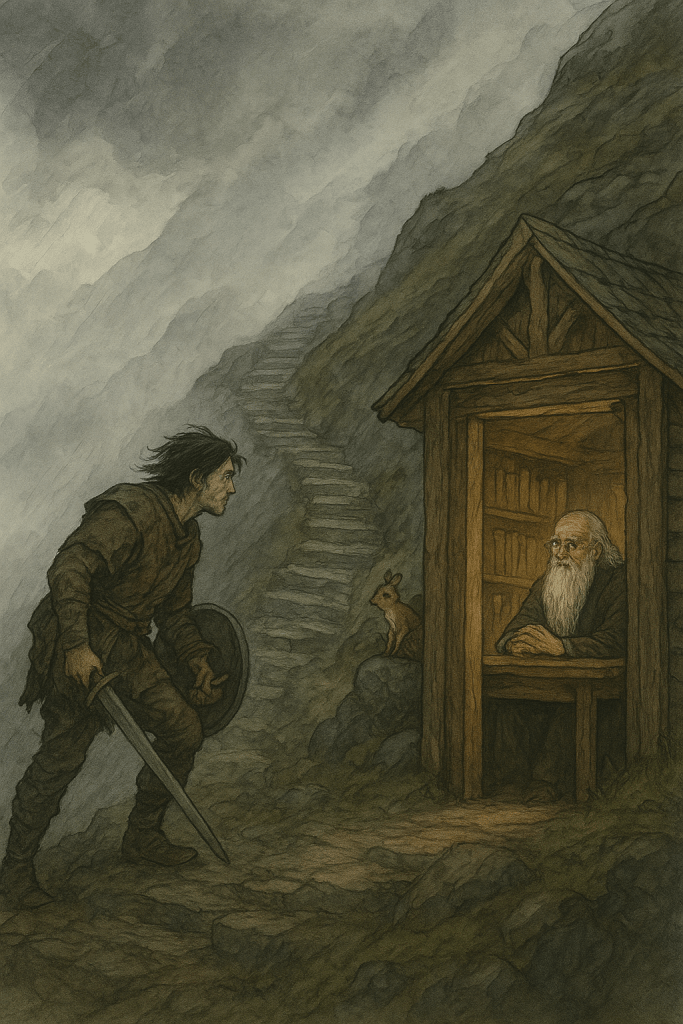
From the open valley he could faintly see a stairway leading up into the mist. The mountain clothed with fog stood before him like an opponent unafraid of his challenging stare. With renewed focus, Axel tightened the blood soaked bandage around his thigh, and trudged on. His resolve grew stronger. The clouds shut out the sun, and the birds flew silently, as though they were hiding something. The minutes turned into hours, and Axel’s sword and burned shield weighed heavy upon him. A squirrel caught sight of the young man, and thought, 

“What? A human so far away from his land? Good heavens, it looks like he’s been through quite a bit. Quite a bit I see. Oh my. Something had clawed at him. Something evil. Something evil I see. Will he climb the mountain? What a sad sight he is. A sad sight I see.”

 The curious squirrel watched Axel take the first step on the mountain’s winding stone stairway. He looked up, and stopped. The wind howled and blew through Axel’s black hair. It had taken him hours to reach the stairwell, and he wasn’t going to stop here. He had come too far. 

Now the tale of the day was that no creature lived on the mountain, and realizing that his battered armor and weapons would slow him down, Axel threw them to his side, and took the first of many steps up into the mist. 

Upward he went, higher and higher, slow and steady. The wind howled continuously, the clouds spewed weighty droplets, and the stones fled from Axel’s feet. One might think the three were set against him, but his stubbornness pushed him on. With sore and bleeding hands he held tightly to the stones protruding from the mountain’s sides. The winding stairway grew narrower and narrower, and each step sent loose stones over the cliff’s edge. He dared not think of home, for doing so would break his focus. One moment of distraction would make him follow the loose stones, down into the fog, never to be seen again. The three seemed to watch his progress with contempt, sending more rain and cold wind upon him, but Axel held to the mountain’s armor, gaining ground with every step. For two days, the winds, rain, and rocks were his only companion. Sleep came in short moments, no more than half a score at a time. Images of his mother sewing by the fireplace filled his dreams with a moment of comfort, until the fireplace morphed into a burning coffin, closing shut upon her. The cold quickly brought him back to the unforgiving mountain where he lay curled up against its side. The third day’s conditions arrived with peculiar violence. 

“I’m nearing the top. I know by the wind’s fury,” he thought. 

As all things considered dangerous and awful intensified, a sudden calm broke through as he took the last step. Axel was blinded. A light seemingly bright as the sun greeted him as the winds and rain ceased. He fell to his knees and placed his wounded hands in the soft grass before him. 

“The tales are true. I’m here,” he whispered. 

Axel recovered his sight, and through the tears forming in his eyes he beheld a lodge, backed by views of the lands below. Now this was not the kind of lodge one would find in human land. No, this was of a different sort. It appeared to be old from one angle, yet new from another. It seemed small from here, yet large from there. It seemed to shift from one shape to another, but this was not bothersome. The cabin seemed to grow more appealing each time it changed, yet Axel could not tell when exactly this happened, only that it did. There was a sense of peace in the air, and the once hostile mountain now seemed relieved.

“This must be the Sage’s home, what I seek is near.” 

Axel picked himself up and knocked on the door. All was silent, until the door creaked and opened slowly. He was surprised to see that no one had opened it. 

“Axel, I’ve been expecting you, come in sir,” an old voice said. “You’re just in time, I’ve put the kettle on the stove. Won’t you join me for tea?” 

Axel walked into the living room and looked around for the voice’s figure. 

“Come into my study and we’ll talk.”

 Looking to his right he could see a room, quite cozy at that, filled with books lined up on the shelves. He followed the sight into what appeared to be a man’s personal library or office, the type of place you might find an author, sitting at his desk while stroking his beard, deep in contemplation. To his left Axel found the stranger, and sure enough, he was sitting at his desk, stroking his long white beard, with the look of someone who swims in deep thoughts. He peered at the young man calmly through his spectacles. Axel wasted no time. 

“I am Axel, son of Adrin, and I’ve come to acquire your wisdom, O excellent Sage. What I seek is an answer to that which all men have sought, but have not found. I believed the old tales about your dwelling here on the Mortal Mountain, and I have traveled from a distant land, through much trial and suffering, even certain death, to stand before you. I pray thee, tell me the secret of life. Why do we suffer loss, pain, and calamity? Though I have inquired of men both high and low, I have not found an answer that satisfies.”

The Sage looked at Axel with tenderness in his eyes. He did not answer right away. His hands remained folded in his lap, and the room grew silent. The old Sage slowly leaned back in his chair, and closed his eyes. Axel grew impatient, until the man spoke.

“My son, were it not for your mother’s passing, you would not have set out on the journey to find me, and by this journey, you have learned the secret. The virtues you will need for the tasks ahead of you were formed by pain in the same way a choicest sword is forged by fire. The enemies you faced in coming here did you much good. You must kill a dragon to get the gold. The gold is virtue. There is no other way. Would you know joy, had you not known sorrow? Would you know prosperity, had you not known calamity? Would you know courage, having never known fear? When you return to human land, you may find yourself a different man than the one you left. That is the point. Your hardships have all been working for your good, preparing you for the calling assigned to you by the Creator. In due time, you may even look back and say, ‘Blessed be the Creator! ’”

Christ Over All (Sermon)

The Text

Colossians 1:13-20

“He has delivered us from the domain of darkness and transferred us to the kingdom of his beloved Son, in whom we have redemption, the forgiveness of sins.

He is the image of the invisible God, the firstborn of all creation. For by him all things were created, in heaven and on earth, visible and invisible, whether thrones or dominions or rulers or authorities—all things were created through him and for him. And he is before all things, and in him all things hold together. And he is the head of the body, the church. He is the beginning, the firstborn from the dead, that in everything he might be preeminent. For in him all the fullness of God was pleased to dwell, and through him to reconcile to himself all things, whether on earth or in heaven, making peace by the blood of his cross.”

Introduction

What do we do when we feel weak? What is our response to a sense of powerlessness? You might have heard the phrase by German Philosopher Friedrich Nietzsche, that quote, “everything is the will to power.” Nietzsche is saying that everything humans do stems from the desire or will to attain power. This begs the question, what is power? The merriam-webster dictionary defines it as “the ability to act or produce an effect.” You most likely do not want to live an ineffectual life, and the idea is that almost every human behavior results from a desire to produce a certain effect in the world. Everything is included, from asking your boss for a promotion (financial power),  posting to social media (influential power), saving money in the bank (security), reading the news (knowledge/informational power), lifting (physical power), correcting people or withholding information, mysteriousness, or openness, or transparency, the list goes on.

Has anyone ever heard that 80s song, “Everybody wants to rule the world” by Tears for Fears? 

Don’t worry I won’t sing it for you… The “seasoned” believers here are shaking their heads. “What do you know about that youngin?” 

Remember those lyrics:

One headline, why believe it?
Everybody wants to rule the world
All for freedom and for pleasure
Nothing ever lasts forever
Everybody wants to rule the world.

Now as we grapple with this idea that all people are on the quest for a sense of completeness, authority, importance, or power, we must ask, how do we see the pursuit of it in the world? We’ve already seen some examples, but more specifically, what is the Christian response to the pursuit of it, or the apparent lack of it? We’ll briefly do this by looking back to the beginning of creation. Genesis 1:28 says this , “God blessed them [that is, Adam and Eve, male and female]; and God said to them, “Be fruitful and multiply, and fill the earth, and subdue it; and rule over the fish of the sea and over the birds of the sky and over every living thing that moves on the earth.” We see that God intended from the beginning for human beings to have power over creation, stewarding it with rule and authority as God’s image bearers on earth. This would tell us, that power is not a bad thing in of itself, but since the rebellion of our first parents, man’s pursuit and use of power has been twisted, and the result is people seeking power apart from God by the least effective methods, like money, appearance, social status, things that don’t last and are like flowers that bloom and eventually fade. Now it is inevitable that people experience a sense of lack. We have an innate desire for the more and the better, which is why consumerism is successful. As Christians, our response to a perceived powerlessness makes all the difference, and the Apostle Paul addresses this sense of lack in the book of Colossians, which brings us to our passage today. 

Colossae

The apostle Paul, although he has never met this congregation face to face, shows love and concern for the Colossian church upon hearing about their faith in Jesus. The city of Colossae, in Rome’s province of Asia, now modern day Turkey, was a wealthy and bustling city prior to New Testament times. Being on a major trade route, Colossae was famous for its thriving wool industry and manufacture of valuable goods. To the dismay of many, this cash flowing trade route was relocated to nearby Laodicea, causing the city to decline. The people who lived there became disgruntled, and Paul understood this. He was speaking to people who had a sense of neediness and decline looming over them. On top of that, they were a new church, and in the ancient world it was a dangerous thing to become a Christian, because doing so was disloyalty to the local gods the community worshiped. The Colossian believers felt powerless, and because of this many were tempted by false teachers to adopt beliefs and practices different from what they had learned. Two primary religious practices of this Jewish and Gentile city were Judaism and Pagan Gnosticism, and this worries Paul. His intention for writing this letter is to remind the Church of Christ’s power, and the power believers have in Him. Verse 13, For He rescued us from the domain of darkness, and transferred us to the kingdom of His beloved Son, in whom we have redemption, the forgiveness of sins.” “Brothers and sisters,” he says, “you are slaves no longer.” Romans 8:15, “For you did not receive the spirit of slavery to fall back into fear, but you have received the Spirit of adoption as sons, by whom we cry, “Abba! Father!” This grasping for solid ground that took place before you knew Christ, is no longer necessary, because you’ve been removed, snatched up, and Jesus says in John 10:28, “I give them eternal life, and they will never perish, and no one will snatch them out of my hand.” Paul means to say that if we have Christ and are in Him, we ultimately have all we need. We have the greatest treasure. In Christ we have been made complete, as Paul says in chapter 2 verse 10. We have died to our old self, and our lives are now hidden with Christ in God. (v3:3) 

Paul’s Message

Paul understands that meditation upon who Christ is acts as a shield, protecting our minds from being carried away by destructive heresies, philosophies, and man-made religion. Now the Colossian church was under a specific temptation, and that was to believe the enemy’s lie, that there was something that they needed, something that they were lacking, that Jesus Christ is not equipped to deal with. This is the same temptation that the serpent used in the garden of Eden. His intention was to make Eve doubt her completeness in God, and convince her that the power she needed was something she would have to attain for herself. This same temptation was later presented in the form of prevalent false teachers in New Testament times, who persuaded Christians to adopt legalistic practices and gnosticism. This sense of lack some of the Colossians had regarding spirituality, wisdom, and knowledge, even within the Church, made them susceptible to false teachers who taught gnosticism, this idea that there is a higher “Christian” experience only attainable through religious practices like worship of angels, contemplation, and visions. This prevalent Philosophy of their day held the idea that the spiritual world is more important or “purer” than the physical one, and in order to achieve true spirituality, one must severely restrict the physical body to better focus on pure spiritual things. Yet Paul is reminding the Colossian Church not to let go of Christ, in whom He says “all the treasures of wisdom and knowledge are found.” (v2:3) He addresses this error in Chapter 2 verse 18, “Let no one disqualify you, insisting on asceticism and worship of angels, going on in detail about visions,  puffed up without reason by his sensuous mind, and not holding fast to the Head (that is Christ)…”. Jesus Christ is sufficient for your soul, Paul says. Stop chasing experiences or ideas that are packaged with the label “higher knowledge.” The Colossian church was not only tempted towards gnosticism. They were also tempted to embrace Jewish legalism, which Paul addresses in chapter 2 verse 20, “If you have died to the elemental spirits of the world, why, as if you were still alive in the world, do you submit to regulations – “Do not handle, do not taste, do not touch (referring to things that all perish as they are used)- according to human precepts and teachings? These have indeed the appearance of wisdom in promoting self made religion and asceticism and severity to the body, but they are of no value in stopping the indulgence of the flesh.” Paul here speaks against man-made religion. What may appear as religious devotion is actually of no value against sin. 

Pietism

We see this same temptation among us today, even among Christians, in a more subtle form, called pietism. The word piety is good, meaning one who has religious reverence, but pietism is “a practice that is designed to lead to an experience that grants you an elite or special status compared to ordinary Christians.” Self-made religion. Brothers and sisters, in times when we forget the power of God in the gospel, there is a tendency to seek power or Christian effectiveness through religiosity. Let me give you some examples. “I missed my Bible reading today, so I’m not right with God.” “If I start doing better, God will love me more.” Refusing movies, music, or clothing, not because they are sinful, but to appear extra devout. Another one might be, relating emotional highs to your spiritual growth as a believer. Pietism. Adding to God’s word. Bob DeWaay, Pastor of Twin City Fellowship in Minneapolis, Minnesota says this about pietism. “The idea that some humanly discovered and implemented method can lead to the achievement of a better Christian life than through the ordinary means of grace is pietism.”

I was speaking with someone recently, let’s call her Sue. Sue said she was driving down the road listening to the Q99.7, and a  song came on that simply wasn’t her style, so she changed the channel to a secular radio station. Less than a minute had gone by before another car had come very close to colliding with hers. The accident was avoided, but it was a very close call. Now Sue said she had a thought after that. “Perhaps this near accident was God warning me about flipping to a secular radio station.” God forbid!

Children of God, the Lord has made you sons and daughters. He is not against you. When it comes to legalism or pietism there is almost this idea that even as a born again Christian, God is watching us closely, with squinted eyes and with crossed arms, suspiciously watching and waiting for us to do something wrong, so that he can swiftly punish us with some unfortunate event or calamity. This is not so. In Christ we have been reconciled to God. We are God’s children. 1 John 3:1 says, “See what kind of love the Father has given to us, that we should be called children of God; and so we are.”

Now what we’ve seen, is that as believers in God, we wrestle with a certain tendency to seek completeness, importance, or power through means other than Jesus Christ. Our natural desire to be effectual people in the world can lead us to consider putting our trust in superficial religious practices that God does not require of us. We must not become bored with the gospel, and move on to something else. Now I am not saying that we should reject the lesser forms of power if God grants them to us, for they are from God, and He gives as He pleases. Steward the talents and abilities you’ve been given, to the glory of God. What I’m saying is not to trust in them ultimately. The Lord gives, and the Lord takes away. Proverbs 11:28, “He who trusts in his riches will fall, but the righteous will flourish like the green leaf.” Some members of the Colossian church either did not fully grasp the power of Christ or they began to forget about Him and look towards legalism and piety to fulfill their sense of need. Paul writes to them about Christ, calling them to remember who He is. Let us do the same.  

Christ is Sufficient

In verses 13-14 Paul is calling the Colossian church to remember what Christ had done for them. He has delivered them from slavery to sin. He has rescued them from the oppressive kingdom of darkness. He has led them into His glorious kingdom. But they must now meditate upon who this deliverer, this rescuer, this leader, truly is. This brings us to the rest of our passage. Verse 15, “For by Him all things were created, both in the heavens and on earth, visible and invisible, whether thrones or dominions or rulers or authorities- all things have been created through Him and for Him.” Isn’t it interesting that Paul starts by saying everything was created by Jesus, and then uses words like thrones, dominions, rulers, and authorities? Paul could have used any other category to describe creation, but he chose to use structures of power. Remember what we said earlier, that Paul is addressing this congregation’s perceived lack of power. They were discouraged. Some members of the church began to embrace false teachings that promised them power and completeness, a “higher” Christianity that they thought they needed. Scripture says no, this is who’s kingdom you’re in. Jesus Christ is sufficient. This man Jesus, the lamb who was slain for the sin of the world, has all authority and power. He is far above the pinnacle of all powers, whether in heaven or on earth. They only exist because he has allowed them to. Jesus Christ is preeminent. Verse 17, “He is before all things, and in Him all things hold together. He is also the head of the body, the church; and He is the beginning, the firstborn from the dead, so that He himself will come to have first place in everything.” Jesus himself taught us something about the nature of true power. While the world’s method is self promotion, Jesus showed us that true power comes by self sacrifice, and it initially takes on the appearance of weakness. We see this in the gospel, that a bleeding, naked, suffocating man on the cross, was “the power of God for salvation to everyone who believes.” (Romans 1:16). Remember when Paul asked God to remove a certain ailment that he perceived as weakness. What did Jesus say to Him in 2 Corinthians 12:9? “My grace is sufficient for you, for my power is made perfect in weakness.” This is why Paul is able to say in verse 24, “I rejoice in my sufferings for your sake.” He knows in whom he has believed, and trusted.

Brothers and sisters, our response to the appearance of powerlessness in our own lives is to meditate on the glory and majesty of the person of Jesus Christ, because we now live in and through Him, by the power of His Spirit. Remember who Jesus is, and you will remember who you are. Religiosity, including forms of it that adamantly claim to discard “religion” in favor of “relationship” cannot produce the culture changing effect we want to see. By virtue of our adoption, we have more power than we know what to do with, for we overcome by the “blood of the lamb and the word of our testimony.” Verse 19, “For it was the Father’s good pleasure for all the fullness to dwell in Him, and through Him to reconcile all things to Himself, having made peace through the blood of His cross; through Him I say whether things on earth or things in Heaven.” God is for you. You are in Him. His power is working for us, helping us to persevere, and we will reach the finish line. 

Paul says to the Colossian church, “In Christ, you are complete. You’ve been blessed with every spiritual blessing in the heavenly places. The Lord’s death, burial, resurrection, and coronation is sufficient for your walk as effectual Christians. All power structures are under the authority of Christ, and we are seated with him in Heaven. To seek any other practice or belief apart from what is revealed in scripture through the gospel is to settle for less. Jesus Christ is sufficient for you.

Matthew 28:18 “And Jesus came and said to them, “All authority in heaven and on earth has been given to me. Go therefore and make disciples of all nations, baptizing them in the name of the Father and of the Son and of the Holy Spirit, teaching them to observe all that I have commanded you. And behold, I am with you always, to the end of the age.”

Let’s pray. 

A Living Person

Dear Friend, 

You may have noticed a change. I’m attending church now and identifying myself as a Christian. Let me tell you why.

 I’ve believed in God’s existence since I was 6 years old and was raised by parents who professed faith in Jesus. This faith I had began to wane as a teenager, as I realized I could not be the good “Christian” I thought God expected me to be, so I called it quits. My freshman year of high school I mocked God publicly and disassociated myself from the label of “Christian”, yet I drove to my first day of senior year joyfully listening to a sermon by John MacArthur. What changed? I came to a realization that Jesus of Nazareth in the Bible did not just live 2,000 years ago, but is actually alive today. I met a person, but this person was not like anyone else I’ve met. His words cut deeply. His behavior showed strength and goodwill. Unlike before, the things He said mysteriously began making sense. The death of this man described in the Gospels made me think that perhaps God does know something about the sorrows of life. I read an apologetics book by Mr. Lee Strobel, and found that the Christian’s belief about Jesus’ resurrection was grounded in reasonableness. But this wasn’t enough for me, nor do I now think that would be enough persuasion for anyone else. The evidence presented, whether prophecy, accuracy of manuscripts, or the Apostle’s testimony post resurrection, were helpful materials for building my faith, but they were and are not the foundation upon which I can call myself a Christian. It is the story itself, and an awareness of a living person. This was a supernatural occurrence, an awareness and conviction that somehow came upon me, resulting in faith. I now understand this to be God’s merciful work by His Spirit, convicting the heart. Sinners hear the news of Christ by the Word (scripture), yet the Spirit confirms within them that what they hear is true and living. It was like a glimmer of light reached me and I was quickened to pursue more of it. To put it simply, Nathaniel’s “kingdom” was invaded by the kingdom of God. Upon the awareness of His life, death, and resurrection, Jesus Christ became to me the ultimate human being, the one who knows what’s really going on, and the way to life everlasting. How can I believe in those preposterous Old Testament stories? If the miracle of the resurrection occurred, then the authority of Christ is sealed, and His confirmation of the Old Testament as history is trustworthy. I can expand on that another time. Right now, my heart is to tell you that I’ve encountered a person, and I want you to encounter Him too. He said if you seek Him you will find Him, for He “desires all people to be saved, and to come to the knowledge of the truth.” For by this man, Paul says, “all things were created, that are in heaven, and that are in earth, visible and invisible, whether they be thrones, or dominions, or principalities, or powers: all things were created by Him, and for Him: and He is before all things, and by Him all things consist.” Jesus of Nazareth, a Jewish Rabbi who called Himself, “the Way, the Truth, and the Life,” was either delusional or God incarnate, and upon encountering Him by His Words, I’ve come to believe the latter.

Friend, my hope is that you will too. 

A Review of Psalm 18 

Psalm 18 is a chapter found in the ancient book of Psalms in the Bible. This piece of writing was created by David, the second King of Israel between 1090 and 970 BC. David wrote this Psalm after the LORD had delivered him from his enemies and securely established him as ruler. Although lament is a common theme found in the book, Psalms chapter 18 can be read as a triumphal ode, a type of lyric poem that combines a thanksgiving prayer with a royal victory song. Psalm 18 contains key truths about God and valuable principles for life. These insights can help us understand both what God has done in the past and how He continues working today.  

David wrote Psalm 18 as an expression of thankfulness after the LORD had delivered him from his enemies and securely established him as ruler of Israel. Passages in other books of the Bible, such as 2 Samuel chapters 8 and 22, describe David’s deliverance from opposition and victory in battle. He expresses his confidence in God and expectation of a successful kingship as he observes God’s power and favor working on his behalf. In the first few verses of Psalm 18, he designates God as his deliverer, strength, rock, fortress, stronghold, and the “horn of my salvation (Ps. 18:2, NASB).” In this poem of thankfulness and triumph, he describes the power of God over creation using apocalyptic imagery, reflecting on God’s response to his prayers. The movement he envisions God undertaking on his behalf amidst life-threatening danger emboldens him to ponder and reflect on the character of Providence. 

What stands out to me the most about this particular Psalm is the idea it sets forth; namely, that God grants favor to those in whom he delights. The bold portrayal of divine grace that made David exult has caused me to do the same as I consider the character of God described in Psalm 18. If God acted on his behalf, will he not also intervene on behalf of His children? In another book of the Bible, 1 Chronicles, chapter 17 describes the promise God made to David. Verses 7 and 8 say,“‘Thus says the Lord of hosts, I took you from the pasture, from following the sheep, to be prince over my people Israel, and I have been with you wherever you have gone and have cut off all your enemies from before you. And I will make for you a name, like the name of the great ones of the earth.” I am encouraged by Psalm 18 because it reminds me of the faithfulness of God. I think of the promises that He has made to me personally. They are rest, eternal life, and the redemption of my body. I say to myself, “If I am one of God’s children, will He not also keep his promises to me, as He did for David?” The Bible teaches that God never changes, and so since He did not break His promise to protect David from harm and establish his kingdom, we can be confident that the rest of His promises will be upheld. The action that God takes on David’s behalf in Psalm 18 shields the mind from temptation to think that God is distant and uninvolved. We have been granted favor by God irrespective of our own sense of goodness.  The apocalyptic imagery in verses  7 through 16 that the psalmist uses to describe the movement of God reinforces His magnificence while strengthening the confidence we can have in His favor. The goodwill we have received as a free gift does not come from a small and inconsequential deity. We have not been shown grace by a figment of our imagination. David’s deliverance from death was not the result of wishful thinking; rather, favor had come from one who causes the “earth to reel and rock”, who’s voice emits “hailstones and coals of fire”, and at whose rebuke “the foundations of the earth were laid bare (The New American Standard Bible, 512).” How great it is to know we on good terms with someone so powerful! 

The writing style of Psalm 18 is straightforward, conspicuous, and the author does not appear to be using subliminal messages in the text. Rather, David seems to employ strong visual descriptions to capture the reader’s imagination and to communicate the urgency of his situation. Statements like “the cords of death encompassed me” can be understood as strong language conveying David’s closeness to death (The New American Standard Bible, 512). It is as if he is saying, death almost swallowed me whole as I became entangled in its grasp. One may argue that David’s use of dream-like imagery from verses 7 through 15 is not straight-forward and is an attempt to produce coded messages. I do not think confusion surrounding this type of language was common for ancient people, David’s target audience. Most ancient cultures accepted the idea of movement in the spiritual realm like what is described in Psalm 18. This complaint may come from difficulty reconciling a modern worldview with an ancient one. People might say David’s supernatural account was deliberately fabricated or was the result of psychedelic drug use, but the Psalm itself suggests neither of these ideas. 

The characters in Psalm 18 are King David himself, God, David’s enemies, and foreign nations. David is portrayed as a man desperately in need. His prayers and thanksgiving are directed to God, a powerful being who shows favor to David by rescuing him from enemies. The foreign nations mentioned are countries nearby who pay David much respect due to his military success. The author repeats certain words and phrases multiple times throughout the text, likely to emphasize certain points or because the Psalm was originally sung out loud. Ancient songs were often accompanied by stringed instruments such as the lyre and harp. King David was a skilled harpist.  

If you wish to know more about God’s dealings with mankind, you might enjoy the glorious truths Psalm 18 reveals. To those in whom God delights, David says the fearful will be strengthened, the needy will be provided for, and the humble will be saved. The reader will leave with an appreciation for God’s grace, while being urged to live a life marked by prayer and dependence on Him. If we see Psalm 18, and even our own lives, in light of God’s grace towards us, we can rejoice and find refuge in Him as David did. 

Works Cited: The New American Standard Bible, Published by Zondervan, 2010.